Thursday, April 26, 2012

Agfa Optima


When: 1959
Why: first fully automatic exposure, 35mm camera.


Fully automatic exposure and it's green! No batteries needed! In the next several years there were a lot of auto-exposure cameras popping up there or there, and guess what, trend continues until now. Try to find a camera without fully automatic settings. Though current cameras do require "food" out of the power lines.

Sunday, October 31, 2010

Alphonse Giroux: Daguerreotype


When:1839.

Why: first "mass"-produced camera, the most valuable camera these days.


Alphonse Guroux, being a relative to Louis-Jaques-Mandé Daguerre, got an exclusive permission from Daguerre and Isidore Niépce (daughter of Daguerre's partner and inventor of the first bellows camera) to manufacture and sell these cameras. It's hard to tell how many of these cameras were manufactured exactly, but they were the first to be manufactured in quantities and to be exported to other countries. Currently these cameras are extremely rare, and prices reach close to a million of $s.

Wednesday, November 4, 2009

Canon: AE-1


When: 1976.
Why: First camera with the microprocessor. First SLR to be sold in millions of units.


The second "why" is actually coming from the first one. The camera was really easy to use (due to the CPU advantages), so many amateur photographers were excited to get it. More than 5 million cameras were sold in total. These days almost every film camera has a microprocessor in it. Also, microprocessor is one of the most important parts inside of all the digital cameras on the market.

Monday, September 14, 2009

Olympus: Pen F


When: 1963
Why: First 35mm half-frame SLR camera.


Compact camera with SLR features and interchangeable lenses? Here it is. This was a successful model and it was followed by Pen FT and Pen FV. Accepts a wide range of prime and zoom lenses from 20mm to 800mm.

Friday, July 17, 2009

Polaroid: SX-70


When: 1972-1977
Why: First truly folding SLR camera, First instant-film SLR camera.


Apparently Polaroid had to create an SLR camera for their instant film. Luckily they made it really portable, and it became somewhat popular. There were many variations later (I was able to find at least 28 different models). There were also non-folding models of SX-70 and numerous international versions which were similar to the USA models. SX-70 model lines were manufactured until 1986 (1982 by some sources), and the compatible film was discontinued in 2006.

Saturday, June 27, 2009

Ihagee: Exakta Vest Pocket


When: 1933
Why: First 127 film SLR.

The first model was known as just "Exakta". This camera is also called Vest Pocket (VP) because of the 127 film, which was originally introduced by Kodak for its "Vest Pocket Kodak" camera. Some of the cameras were fitted with extremely fast f1.9 or f2 lens for those years, and they were called "Night Exakta".

Ihagee: Kine Exakta


When: 1936
Why: First production version of 35mm SLR, first system SLR, first interchangeable lens camera with bayonet lens mount


Ihagee was already known for the first 127 film SLR in 1933 and just in three years they introduced a first 35mm SLR too. But here is why I had to add "production" word: the first 35mm SLR prototype was a Soviet Union camera named Sport (Спорт) in 1934. Unfortunately it didn't go into production for another three years, so Ihagee stepped in first.

Monday, January 12, 2009

Hasselblad 1600F


When: 1948.
Why: First trully modular SLR camera.


Hasselblad cameras are still used by professionals (mostly) and they still have the same modular design - interchangeable everything: lens, back, viewfinder. 1600F was the first camera by Hasselblad (excluding military aicraft models) in their long line of medium format SLRs. These cameras are somewhat expensive, but they offer excellent flexibility. These days you can even get a digital back that attaches to the same film body.

Tuesday, November 25, 2008

Eastman Company: Kodak (Original)


When: 1888.
Why: First "point and shoot" camera for non-professional photographers.


Also, this is the first camera by George Eastman, inventor of transparent photographic film. "Point and shoot" relates to one of the best known slogans in photographic industry: "You press the button - we do the rest". And that was true. Photography enthusiasts had to press button (100 times for 100 photos on the roll) and send camera back to "The Eastman Dry Plate and Film Company" which developed film, printed photos, reloaded camera, and sent it back to customer for $10. In 1888 this pre-loaded camera was offered for $25 (kind of a high price back then), and currently it can go for up to $5000. Check out the Eastman's patent for this camera.

UPD: As it appears, George Eastman was not the "first" inventor of transparent film, nevertheless he popularized it, starting a huge change in the photography history.

Monday, November 17, 2008

Gamma Works: Duflex


When: 1947
Why: First SLR with instant return mirror.


This is the Hungarian camera, designed and built in Budapest, by Jeno Dulovits. Unfortunately focusing and viewing were separate operations but "Asahiflex IIb" came out on 7 years fixing this inconvenience. Since there were only about 800 Duflex cameras manufactured, the Asahiflex IIb one is usually called the first mass-produced SLR with instant return mirror. Currently, this feature is "a must" in any modern SLRs.

Duflex was also the first SLR to implement metal sheet focal plane shutter. Novacon site is a great source of information about this camera.

Thursday, November 13, 2008

Franke & Heidecke: Rolleiflex Original


When: 1929
Why: First rollfilm TLR (Twin-Lens-Reflex).


Also it's a first medium format Franke & Heidecke camera. Franke & Heidecke manufactured a couple of stereo TLR camera models before (Rolleidoscop), but again, those were stereo cameras, not exactly suitable for the regular job. Rolleiflex Original was an instant success, and became a parent of many more TLR models which are still produced. You can find detailed specs of this camera on the Rollei Club web-site.

Wednesday, November 12, 2008

Ernemann: Ermanox


When: 1924
Why: Fastest lens at the time.


Ermanox is mostly known for its Ernostar 100/2 and 85/1.8 lenses. Even now, 100/2 lenses are considered as extremely fast, but in 1924 they were revolutionary, allowing previously impossible low light photography without a flash. A couple of years later, Ernemann introduced Ermanox Reflex which is highly sought by collectors and fetching really high prices.

Zeiss Ikon continued production of Ermanox after merger with Ernemann. Later, Ermanox lenses became a base for Contax Sonnar fast lenses line.

Tuesday, November 11, 2008

Tokyo Kogaku: Topcon RE Super


When: 1963
Why: First TTL (through-the-lens exposure meter) SLR camera.


Though TTL was already on the market with non-SLR "Mec 16 SB" camera, Topcon came in with several nice features: SLR (of course), interchangeable lens, interchangeable viewfinders, motor drive option. Currently, TTL is very important for SLR cameras mostly because of different interchangeable lens and different lens filters.

Very detailed camera description can be found at The Casual Collector web-site.

Monday, November 10, 2008

Konishiroku: Konica C35 AF


When: 1979
Why: First autofocus camera


Welcome to the modern world of autofocus. Konishiroku used a Visitronic AF system designed and manufactured by Honeywell. It was expensive camera with passive system (comparing to active infrared ones) and only two photocells, nevertheless it started a significant change in the cameras world. Today it's almost impossible to find a new camera/lens without autofocus feature.

Also, this camera was almost fully automatic. The only manual thing you'd need to do is rewind.

You can find several samples of camera output on Zeno Felkl C35 AF page.

Wednesday, November 5, 2008

Kodak: No.3A Autographic Special


When: 1917
Why: No.3A Autographic Kodak Special was the first coupled rangefinder camera ever


While rangefinders (or "telemeters") were introduced in the beginning of 1900s, they were used as optional accessories and were not linked to the taking lens (non-coupled). Their measured values had to be transmitted to the focusing scale manually.

Coupled rangefinder was "automatic" if I can say so. "Kodak Range Finder" (you can see it as a rectangular box under the lens) had three vertical mirrors in place (camera had to be held horizontally), and image in the middle one was shifting up or down when focusing was changed.

The whole new era started with this camera introduction. Rangefinders became an industry standard until SLR cameras didn't push rangefinders out.

Tuesday, November 4, 2008

VEB Zeiss Ikon: Contax S


When: 1949
Why: this is the first SLR (Single-Lens Reflex) camera to use pentaprism. Also it is the first camera to use 42mm screw lens mount (M42)


Pentaprism allowed non-reversed direct viewing from behind the camera, opposing to older SLRs top-view and reversed image. Pentaprism (or cheaper version: pentamirror) became an industry standard for modern SLR cameras. M42 mount, which was introduced for this camera, became an industry standard for 35mm cameras too. Later, M42 was called as "Pentax thread mount", "Praktica mount" and "Universal Screw mount" and was used on lots of SLR cameras.

Very detailed description of this camera can be found at the Rick Oleson's web-site.

Monday, November 3, 2008

Dycam Model 1 (Logitech FotoMan)


When: 1990
Why: First trully digital camera to be sold on the market.


  • It had only 320x240 and later 376x284 resolution;
  • It produced only black/white photos with 256 gray levels;
  • It had only 1Mb internal RAM;
  • It had fixed focus f4.5 lens;
  • It did cost $980 (£499)!

Still, it was fully digital (not analog like Sony Mavica)! You can find a nice hand-on experience description on John Henshall web-site.

P.S. Kodak's DCS100 appeared half a year later.

Wednesday, October 29, 2008

Polaroid: Land Camera Model 95


When: 1948
Why: first commercially available instant picture camera.


This is the first Polaroid model, and an instant hit on the market. Camera was easy to use, black/white (actually brown/white) photo was ready in one minute, almost automatic (only 8 settings of shutter/aperture) usage. It's not the first instant camera, by no means, but it's the first successful and mass-produced camera. You can find a remarkable description of the camera at The Land List web-site.

The first instant photo camera was actually the "Patent Camera Box" (1857) by Bolles & Smith, also American company. It was a wooden-box, wet plates camera, but it was not very successful on the market.

Monday, October 27, 2008

New Ideas (Herbert & Huesgen): Tourist Multiple


When: 1913
Why: Officially first commercially produced 35mm film camera.


It did not gain a lot of popularity like "Leica I", but New Ideas Manufacturing (part of a Herbert & Huesgen, American company) produced almost 1000 cameras. And... Hold your breath: it was capable of taking 750 exposures per one film load. Body looked like a movie camera.

Several months later, the first 35mm stereo camera was manufactured by Jules Richard (France). It was "Homeos" which will be covered in one of the next posts.

Sunday, October 26, 2008

Leitz: Leica I (A)


When: 1925
Why: First mass-produced camera which popularized 35mm format.


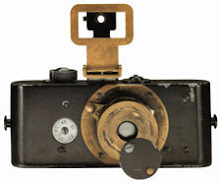
There were several attempts to introduce 35mm format (which was used in movie cameras) to the still cameras market, but they all remained in shadow until "Leica I" made it's way out of Ernst Leitz company. Oskar Barnack, camera designer, created a first prototype in 1914. It was called "Ur Leica" and was not sold on the market. Second prototype was "Leica 0-Series", but it took more than 10 years to start a commercial production of these cameras. Early models had Anastigmat f3.5/50mm lens. You may find other varieties of Leica I A on camerapedia. As far as why this camera became so popular, there are several theories:

  • The lens quality was outstanding. Leitz company was already well-known in optical and microscopes industry;
  • Size of the camera was really small comparing to other quality cameras;
  • Mechanics precision was really good. You can still use some of these early Leicas;
  • Some historians suggest a high price of this camera as a "prestige" attraction.

Out of all previous 35mm cameras, there was only one commercially produced model: Tourist Multiple by Herbert & Huesgen. I'll cover it in the next post.