Showing posts with label viewfinder. Show all posts

Wednesday, November 12, 2008

Ernemann: Ermanox


When: 1924
Why: Fastest lens at the time.


Ermanox is mostly known for its Ernostar 100/2 and 85/1.8 lenses. Even now, 100/2 lenses are considered as extremely fast, but in 1924 they were revolutionary, allowing previously impossible low light photography without a flash. A couple of years later, Ernemann introduced Ermanox Reflex which is highly sought by collectors and fetching really high prices.

Zeiss Ikon continued production of Ermanox after merger with Ernemann. Later, Ermanox lenses became a base for Contax Sonnar fast lenses line.

Monday, October 27, 2008

New Ideas (Herbert & Huesgen): Tourist Multiple


When: 1913
Why: Officially first commercially produced 35mm film camera.


It did not gain a lot of popularity like "Leica I", but New Ideas Manufacturing (part of a Herbert & Huesgen, American company) produced almost 1000 cameras. And... Hold your breath: it was capable of taking 750 exposures per one film load. Body looked like a movie camera.

Several months later, the first 35mm stereo camera was manufactured by Jules Richard (France). It was "Homeos" which will be covered in one of the next posts.

Sunday, October 26, 2008

Leitz: Leica I (A)


When: 1925
Why: First mass-produced camera which popularized 35mm format.


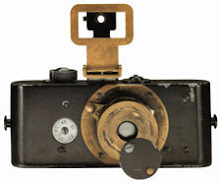
There were several attempts to introduce 35mm format (which was used in movie cameras) to the still cameras market, but they all remained in shadow until "Leica I" made it's way out of Ernst Leitz company. Oskar Barnack, camera designer, created a first prototype in 1914. It was called "Ur Leica" and was not sold on the market. Second prototype was "Leica 0-Series", but it took more than 10 years to start a commercial production of these cameras. Early models had Anastigmat f3.5/50mm lens. You may find other varieties of Leica I A on camerapedia. As far as why this camera became so popular, there are several theories:

  • The lens quality was outstanding. Leitz company was already well-known in optical and microscopes industry;
  • Size of the camera was really small comparing to other quality cameras;
  • Mechanics precision was really good. You can still use some of these early Leicas;
  • Some historians suggest a high price of this camera as a "prestige" attraction.

Out of all previous 35mm cameras, there was only one commercially produced model: Tourist Multiple by Herbert & Huesgen. I'll cover it in the next post.