Showing posts with label 35mm. Show all posts

Wednesday, November 4, 2009

Canon: AE-1


When: 1976.
Why: First camera with the microprocessor. First SLR to be sold in millions of units.


The second "why" is actually coming from the first one. The camera was really easy to use (due to the CPU advantages), so many amateur photographers were excited to get it. More than 5 million cameras were sold in total. These days almost every film camera has a microprocessor in it. Also, microprocessor is one of the most important parts inside of all the digital cameras on the market.

Monday, September 14, 2009

Olympus: Pen F


When: 1963
Why: First 35mm half-frame SLR camera.


Compact camera with SLR features and interchangeable lenses? Here it is. This was a successful model and it was followed by Pen FT and Pen FV. Accepts a wide range of prime and zoom lenses from 20mm to 800mm.

Saturday, June 27, 2009

Ihagee: Kine Exakta


When: 1936
Why: First production version of 35mm SLR, first system SLR, first interchangeable lens camera with bayonet lens mount


Ihagee was already known for the first 127 film SLR in 1933 and just in three years they introduced a first 35mm SLR too. But here is why I had to add "production" word: the first 35mm SLR prototype was a Soviet Union camera named Sport (Спорт) in 1934. Unfortunately it didn't go into production for another three years, so Ihagee stepped in first.

Monday, November 17, 2008

Gamma Works: Duflex


When: 1947
Why: First SLR with instant return mirror.


This is the Hungarian camera, designed and built in Budapest, by Jeno Dulovits. Unfortunately focusing and viewing were separate operations but "Asahiflex IIb" came out on 7 years fixing this inconvenience. Since there were only about 800 Duflex cameras manufactured, the Asahiflex IIb one is usually called the first mass-produced SLR with instant return mirror. Currently, this feature is "a must" in any modern SLRs.

Duflex was also the first SLR to implement metal sheet focal plane shutter. Novacon site is a great source of information about this camera.

Tuesday, November 11, 2008

Tokyo Kogaku: Topcon RE Super


When: 1963
Why: First TTL (through-the-lens exposure meter) SLR camera.


Though TTL was already on the market with non-SLR "Mec 16 SB" camera, Topcon came in with several nice features: SLR (of course), interchangeable lens, interchangeable viewfinders, motor drive option. Currently, TTL is very important for SLR cameras mostly because of different interchangeable lens and different lens filters.

Very detailed camera description can be found at The Casual Collector web-site.

Monday, November 10, 2008

Konishiroku: Konica C35 AF


When: 1979
Why: First autofocus camera


Welcome to the modern world of autofocus. Konishiroku used a Visitronic AF system designed and manufactured by Honeywell. It was expensive camera with passive system (comparing to active infrared ones) and only two photocells, nevertheless it started a significant change in the cameras world. Today it's almost impossible to find a new camera/lens without autofocus feature.

Also, this camera was almost fully automatic. The only manual thing you'd need to do is rewind.

You can find several samples of camera output on Zeno Felkl C35 AF page.

Tuesday, November 4, 2008

VEB Zeiss Ikon: Contax S


When: 1949
Why: this is the first SLR (Single-Lens Reflex) camera to use pentaprism. Also it is the first camera to use 42mm screw lens mount (M42)


Pentaprism allowed non-reversed direct viewing from behind the camera, opposing to older SLRs top-view and reversed image. Pentaprism (or cheaper version: pentamirror) became an industry standard for modern SLR cameras. M42 mount, which was introduced for this camera, became an industry standard for 35mm cameras too. Later, M42 was called as "Pentax thread mount", "Praktica mount" and "Universal Screw mount" and was used on lots of SLR cameras.

Very detailed description of this camera can be found at the Rick Oleson's web-site.

Monday, October 27, 2008

New Ideas (Herbert & Huesgen): Tourist Multiple


When: 1913
Why: Officially first commercially produced 35mm film camera.


It did not gain a lot of popularity like "Leica I", but New Ideas Manufacturing (part of a Herbert & Huesgen, American company) produced almost 1000 cameras. And... Hold your breath: it was capable of taking 750 exposures per one film load. Body looked like a movie camera.

Several months later, the first 35mm stereo camera was manufactured by Jules Richard (France). It was "Homeos" which will be covered in one of the next posts.

Sunday, October 26, 2008

Leitz: Leica I (A)


When: 1925
Why: First mass-produced camera which popularized 35mm format.


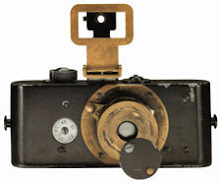
There were several attempts to introduce 35mm format (which was used in movie cameras) to the still cameras market, but they all remained in shadow until "Leica I" made it's way out of Ernst Leitz company. Oskar Barnack, camera designer, created a first prototype in 1914. It was called "Ur Leica" and was not sold on the market. Second prototype was "Leica 0-Series", but it took more than 10 years to start a commercial production of these cameras. Early models had Anastigmat f3.5/50mm lens. You may find other varieties of Leica I A on camerapedia. As far as why this camera became so popular, there are several theories:

  • The lens quality was outstanding. Leitz company was already well-known in optical and microscopes industry;
  • Size of the camera was really small comparing to other quality cameras;
  • Mechanics precision was really good. You can still use some of these early Leicas;
  • Some historians suggest a high price of this camera as a "prestige" attraction.

Out of all previous 35mm cameras, there was only one commercially produced model: Tourist Multiple by Herbert & Huesgen. I'll cover it in the next post.